Radar
Spatial Kata Notation: writing kata so you can see where you are facing
Karate kata is spatial. You turn, you step, you change facing, and the floor pattern (embusen) is half the work of remembering a form. Most of my notes after class were still paragraphs: technique names in order, with facing lost in the sentence if I remembered to write it down at all.
I wanted something I could read on a phone between sets, paste into a chat, or print without opening an app. That became Spatial Kata Notation (SKN): a plain-text tree for kata and bunkai. The site and generator live in an open repo here:
https://github.com/hasantayyar/spatial-kata-notation
Live docs and the tool: https://hasantayyar.github.io/spatial-kata-notation/
This is an early, working documentation site plus a generator. The first full kata example is Pinan Nidan on a Shito-Ryu reading I use for study. Other kata and schools can be written the same way if someone wants to contribute sheets, as long as they are labeled clearly and treated as notes, not canon.
If you train, try writing one short section of a kata you know in SKN after class. If the facing line feels redundant, good: that means you already had it clear. If you keep correcting the facing line, the notation is doing its job.
What problem this is trying to solve
Traditional teaching does not need a new notation. Sensei shows, corrects, and repeats. Students absorb timing, posture, and intent on the floor.
What does fail often is private review. After class you try to reconstruct:
- which way you were facing after the third turn
- whether the punch was oi-tsuki or gyaku-tsuki
- how a two-part transition was ordered (for example gedan-barai, then pull to nekoashi with otoshi)
Paragraph notes hide that structure. A diagram can help, but diagrams are awkward to edit in a notebook or message. SKN keeps the sequence as text, and puts movement and facing in the spine of each line.
A single move looks like this:
+-- [STEP → N] -------------- (Face: N)
|   ├─ Stance : [R] Z-D
|   ├─ Action : Right Age-uke (J)
|   └─ Key    : Rise under attack angle
You read top to bottom. Each +-- branch is one beat. Face is orientation after the move, not a floor coordinate. Stances use short codes (Z-D, N-D, S-D). Heights stay as J / C / G.
Turns are written toward a destination facing, for example [MAWATTE → W], with optional quality notes like · deep when useful.
Design choices that mattered
A few early drafts used degrees everywhere (TURN 90° W) and labeled facing as Position. That was ambiguous. Destination facing first is easier to scan. Degrees and “deep / soft” stay optional.
Multi-beat transitions nest under one move:
+-- [MAWATTE → E] ----------- (Face: E)
|   ├─ Beat 1 : [R] Z-D
|   │   └─ Action : Right Gedan-barai (G)
|   ├─ Beat 2 : Pull back into [R] N-D
|   │   └─ Action : Right Tetsui Otoshi-uchi / Otoshi-uke (C)
|   └─ Note   : Distinct two-part transition
Bunkai can stay on the same spine with a Bunkai line, or use a dual attacker/defender layout when you are studying partner work. The repo’s Pinan Nidan opening example uses a 45° off-axis reading; that is one possible application, not a claim of orthodoxy.
The character on the site mark is 形 (form), the spelling used in much modern karate for kata, rather than 型.
Hard rule: notation is subordinate to teaching
If a sheet disagrees with your sensei, the sheet is wrong. Update the sheet.
SKN is for:
- remembering embusen after class
- reviewing sequence before solo practice
- sharing a draft with training partners
- annotating one bunkai reading you were actually shown
It is not a grading tool, a style authority, or a substitute for partner work in the dojo. Every sheet should name the school reading it follows (for example Shito-Ryu, or dojo-specific).
That sounds obvious. It is also the part most “systems” forget once they get a logo.
What is in the repo
The project is a static Astro site on GitHub Pages.
- Philosophy / Guide / Reference: why it exists, how to read a sheet, and the compact key
- Example: full Pinan Nidan (Shito-Ryu reading) in SKN
- Bunkai page: partner-layout sample tied to the opening
- Keiko (practice generator): client-side tool that either
- parses a pasted kata sheet into practice loops (auto, facing groups, isolated tech), or
- builds a Shito-ryu kihon plan with no sheet, filtered by max belt so a yellow belt is not asked to drill Tsugi-ashi by name
The kihon catalog is a practical vocabulary list with belt floors, not an official federation syllabus. Dojos differ. Again: sensei first.
Under the hood the useful bits are small TypeScript modules: an SKN parser for kata spines, a practice-plan generator, and the kihon catalog. No account system, no timer coach, no backend. Plain text in, plain text plan out, copy button.
Why plain text
I care about a few boring properties:
- Diffable. You can put sheets in git and see what changed.
- Portable. Works in email, chat, Markdown, paper.
- Readable without software. The website helps; it is not required to use the notation.
- Honest about limits. A tree will not carry kime, breathing, or the feel of a correction. It carries labels and order.
June '26 - Everything I Learned
Every month I share the things I leraned and remembered to write down somewhere. Here are the June notes.
Berlin is serious about bats
I discovered a naturbelassener Park around Tempelhof nearby my apartment. Berlin quietly protects a lot of semi-wild spaces like bats.
NABU Berlin says that Berlin is the “capital of bats”: 18 bat species have been recorded in the city, and up to 11,000 bats overwinter in the Spandau Citadel alone. (NABU - Naturschutzbund Deutschland e.V.)
Nazi drug experiments
While I show a Nazi era concentration camp to my family during their visit to Berlin, I learned lots about the drug experiments in these camps.
Nazi doctors conducted radical medical experiments on concentration camp prisoners without consent. I knew it already but I didn't know there were inhumane cocaine experiments and some psychedelics as well. The US Holocaust Memorial Museum groups these experiments into survival, drug-treatment, and ideological/racial categories. (Holocaust Encyclopedia)
More specifically, SS doctor Kurt Plötner is associated with mescaline experiments at Dachau, apparently connected to interrogation and “truth serum” research. These expreiments later mentioned on LSD researches. (Cambridge University Press & Assessment)
Eichenprozessionsspinner
I learned the story behind the German word that looks like a keyboard accident: Eichenprozessionsspinner, the oak processionary moth. the city was invaded, probabyl still is. Especially in the outer parts.
The adult moth is not the main issue. The caterpillars are. Their tiny hairs contain an irritating toxin and can cause skin, eye, throat, and allergic reactions.
Berlin is a good habitat for them because the city has many oaks in parks and along streets. (Berlin.de)
Plants that keep appearing
My father once pointed out a wild herb named (in Turkish) sinir otu to me on a Berlin sidewalk. He mentioned that it's a medically important herb. I did not care much at the time. Now I keep seeing it everywhere.
The German name is Spitzwegerich, in English ribwort plantain, and its Latin name is Plantago lanceolata. The European Medicines Agency lists it as a traditional herbal medicine used for throat irritation, dry cough, cough with cold, and minor skin inflammation. (European Medicines Agency (EMA))
Also learned that blackberry tea is great for eye pressure apperently. I am not turning this into medical advice. It is just good tea actually.
Barry’s Berlin
Barry’s gymb Berlin gave me a small anthropology moment :/
Luxury gym, waiting list, strange people waiting outside, weird Google Maps energy, and a visible upper class snob culture fitness.
NUMA finally clicked
I learned more about NUMA, short for Non-Uniform Memory Access.
Small server:
CPU <-> RAM

Large multi-socket server:
CPU0 <-> RAM0
CPU1 <-> RAM1
CPU2 <-> RAM2
CPU3 <-> RAM3
Each CPU socket has memory that is physically closer to it. Local memory access is faster. Remote memory access still works, but it crosses the interconnect and costs more latency. Red Hat describes NUMA as a design where memory resources are allocated close to a CPU to improve access time. (Red Hat Documentation)
Linux exposes this topology nicely:
numactl --hardware
lscpu | grep NUMA
numastat
numactl --show
The practical lesson: big servers are not just “more CPU and more RAM”. Placement matters. Threads and memory should ideally live close to each other. Otherwise, a powerful machine can quietly waste performance by moving data across sockets.
Linux also has NUMA memory policy support, which controls from which NUMA node memory gets allocated. (Kernel Documentation)
Strudel and TidalCycles
I tried to configure Strudel and TidalCycles locally, then discovered that Strudel already works in the browser.
Strudel is basically a browser-based live coding environment that ports the TidalCycles pattern language to JavaScript. (Strudel)
Music rabbit holes
A great house track from Saudi Arabia:
Shoft Alhala, Radio Edit, by Vinyl Mode and Moayad
I also learned about Assa’d Khoury’s Electronic Touches Belly Dance, a 1978 Lebanese instrumental album built around funky electronic keyboards and Arabic melodies. It was reissued in 2026 after nearly 50 years. (WEWANTSOUNDS)
The most interesting part for me was the modified Farfisa-style keyboard world: electronic organs adapted for Oriental scales and quarter-tones. Arabic music needs pitches that standard Western keyboards do not naturally provide. This similar trend of tuning off the keyboards can also be observed other sub-cultures in North and central Africa.
AWS “What is” pages
I appreciated AWS’s “What is” pages.
The computer chip explanation is simple, direct, and mostly free of forced metaphors. It explains chips, silicon, etching, analog circuits, digital circuits, ASICs, SoCs, and AWS custom chips like Graviton, Inferentia, and Trainium in a clean way. (Amazon Web Services, Inc.)
Good technical writing does not always need storytelling.
May '26 - Everything I Learned
Zirkus Mond
I went of the Zirkus Mond shows called "What is Zirkus". It was fantastic.
One thing that surprised me was a handmade "robot" used during the performance. The presenter explained how circuses have always followed new technologies closely and turned them into art. In some ways, circuses have historically been early adopters of technology rather than followers.
Where Have All the Sparrows Gone?
Apparently Berlin's sparrow population is declining rapidly and nobody is completely sure why.
One theory I found interesting is that while adult sparrows can eat seeds and crumbs, baby sparrows depend almost entirely on insects during their first weeks of life. With insect populations collapsing due to pesticides and increasingly manicured urban environments, many chicks simply don't get enough food.
Urban colonies are also vulnerable to diseases such as Salmonella and avian malaria, especially when combined with pollution and noise.
The Gold Under an Indian Temple
I learned about the enormous treasure discovered in the vaults of an Indian temple.
The amounts involved are so large that estimates reach tens of billions of dollars in gold, jewels, coins, and artifacts accumulated over centuries of donations. The discovery triggered legal battles, security concerns, and debates about ownership and preservation.
One of those stories that sounds fictional until you realize it actually happened.
The Smithsonian on Unsplash
The Smithsonian has published around 1,000 images on Unsplash.
What surprised me is the scale of the institution itself. The Smithsonian isn't just a museum—it's 21 museums, libraries, research centers, and even a zoo.
Hundreds of years of art, science, culture, and history are now much easier to access and reuse.
Bromantane
I discovered Bromantane, a Russian drug originally developed for improving physical and mental performance.
It acts as both a stimulant and an anxiolytic, which is a strange combination. Unlike classical stimulants such as amphetamine, its exact mechanism is still not fully understood.
It's sometimes described as an "adaptogen" or "actoprotector", terms I had never encountered before.
Yogi Kazım
I came across the story of Yogi Kazım.
One of those unusual figures who seem to exist somewhere between performance art, spirituality, self-invention, and local legend. Definitely a rabbit hole worth exploring.
https://tam-museum.org/yogi-kazim
Yogi Kazim lived long and his own developed methods which are influced from Yoga and many other studies.
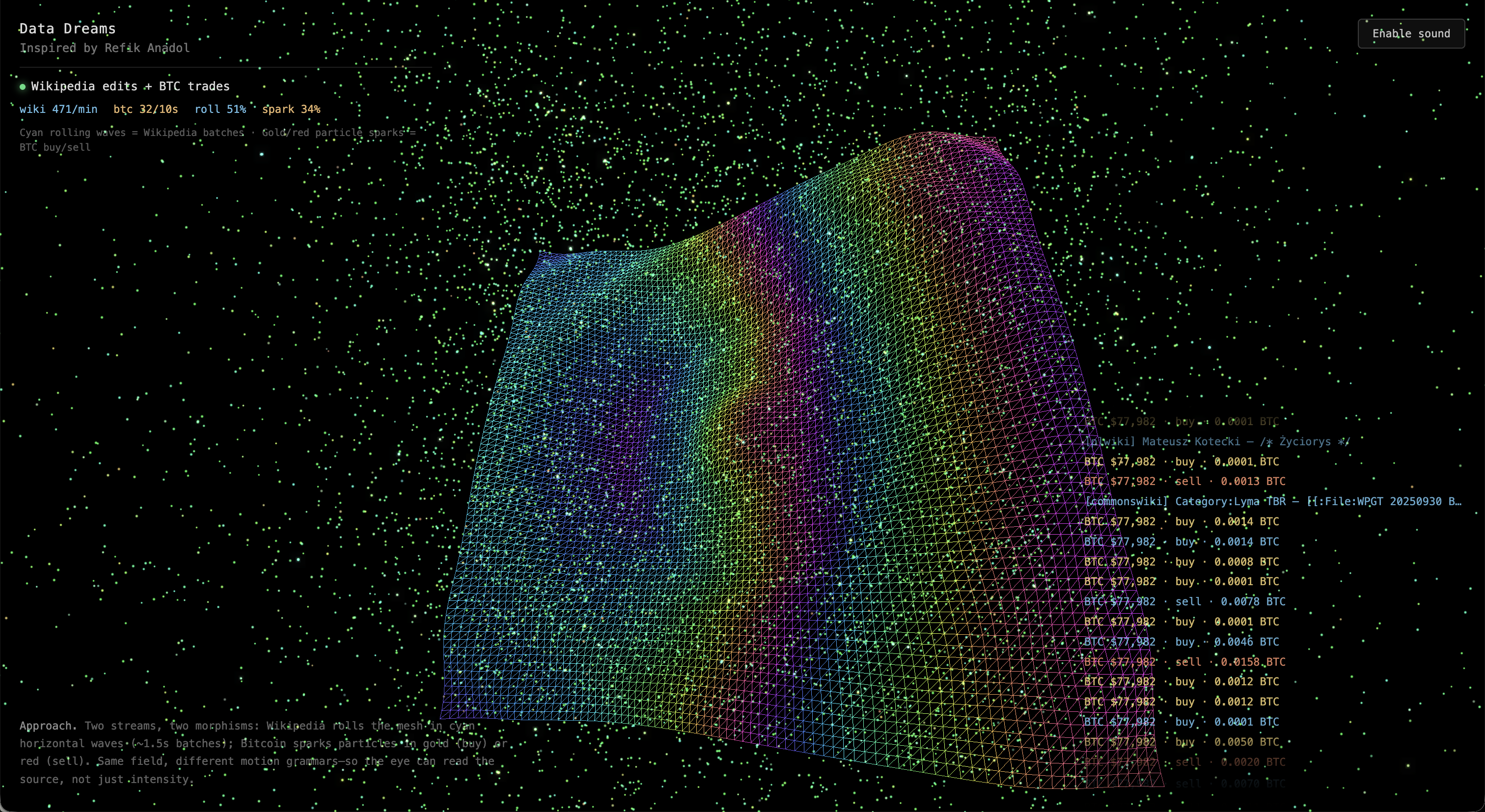
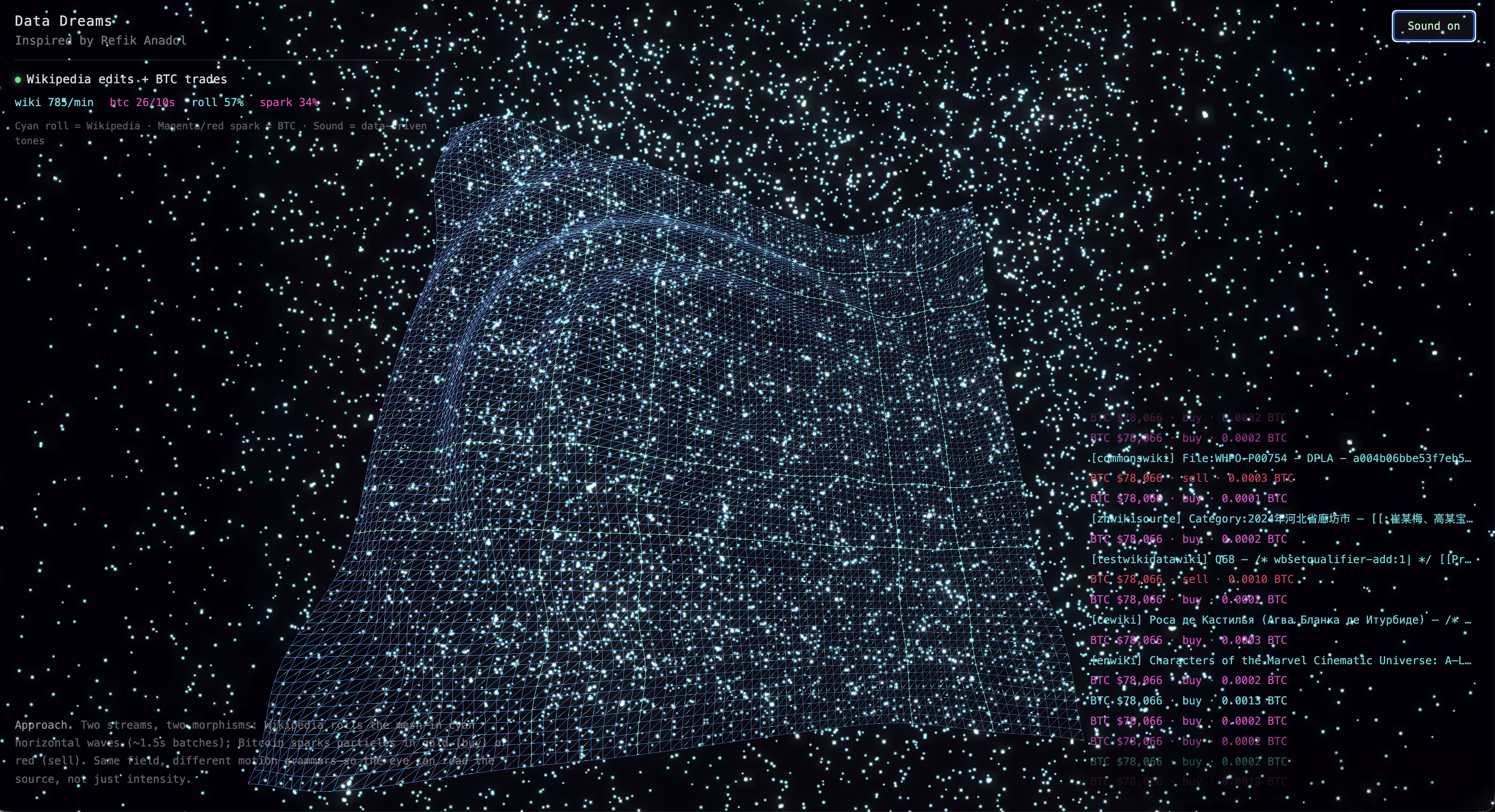
Audio and visual work from Wikipedia updates and BTC trades
Attention: rapid image transitions, and visual effects that may affect viewers who are sensitive to flashing imagery or have photosensitive epilepsy.
April '26 - Everything I Learned
Georg-von-Rauch-Haus
A building next to my office has much more interesting history than anybody passing by expected.
The Georg-von-Rauch-Haus was occupied by activists in 1971 during West Berlin's housing protests and became one of the symbols of Berlin's squatter movement. It is named after Georg von Rauch, an activist who was killed by police shortly before the occupation.
There this amazing symbol song about the house https://www.youtube.com/watch?v=TYSFGT7UGS8
The Art Manifesto at Bethanien
I visited an exhibition at Bethanien and ended up spending more time thinking about an art manifesto than the artwork itself.
Bethanien itself has an interesting history. It started as a hospital in the 19th century and later became one of Berlin's most important cultural and artistic spaces.
Gecekondu at Kottbusser Tor Berlin
There is a small hut near Kottbusser Tor called "Gecekondu".
"Gecekondu" is a Turkish word meaning "built overnight". This one was built as a protest against rising rents and the privatization of social housing in Berlin.
Behind it is Kotti & Co, a movement formed by local residents, many from Turkish guest-worker families. What looks like a simple wooden hut is actually a political meeting point, community center, and symbol of resistance against displacement.
There are many dramas foing on inside this initiative but the hut standing there is a real statement.
Schwerbelastungskörper
I didn't know that there was a giant concrete cylinder in Tempelhof without an active purpose right now.
The Schwerbelastungskörper ("heavy load-bearing body") was built by Albert Speer between 1941 and 1942 to test whether Berlin's ground could support a gigantic triumphal arch planned by the Nazis.
The arch was supposed to be around three times larger than the Arc de Triomphe in Paris.
The arch was never built, but the test structure remains. It is one of the strangest reminders of how ambitious and absurd some of the plans for Nazi Berlin were.
Timmy the Whale
I went down a rabbit hole reading about Timmy, a whale that became a national story in Germany.
What interested me most was the public reaction. Scientists argued that intervention would likely cause more suffering and that the whale should be left alone, but many people demanded that something be done.
Germans went a bit too emotional almost hysterical on this topic.
March '26 - Everything I Learned
I usually take notes and try to follow the slipbox technique for storing the new information that I find out interesting during a month. This month I didn't take notes as an experiment to see how much I will remember. Turns out slipbox note taking is important.
The Nepal Royal Massacre: The Impossible King
The 2001 massacre of the Nepalese royal family remains one of the strangest royal tragedies in modern history. In June 2001, Crown Prince Dipendra of Nepal allegedly killed nine members of his own family, including the king and queen, reportedly over a dispute about his marriage, before shooting himself. The massacre did not just devastate the royal family. It also threw the monarchy into chaos, led to the surreal 54-hour reign of a king in a coma, and gave rise to conspiracy theories that would shadow the throne until its eventual abolition.
What makes the story especially interesting is how absurd the events after became. After shooting his family and himself, Dipendra fell into a coma. Even so, he was officially declared king and remained on the throne for three days before dying, creating the bizarre spectacle of a monarch who reigned without ever regaining consciousness.
Public suspicion quickly turned toward Gyanendra, the dead king’s brother. He was conceniently absent from the dinner, while his immediate family escaped with only minor injuries. His first public explanation, that the massacre resulted from an “accidental discharge of an automatic weapon,” was so implausible that it only deepened distrust and further damaged the monarchy’s legitimacy.
Cicero’s De Oratore
People say Cicero must be read in Latin but that will be impossible for me. I have a plan to read in English or Turkish in the future. I believe it will inspire many who wants to be better in public speaking. Writing in the crumbling Roman Republic, Cicero’s work on the "Ideal Orator" argues that technical skill is secondary to character. Search for Marcus Tullius Cicero, De Oratore (Book I-III). For Cicero, rhetoric without wisdom is a weapon: persuasive power without ethics becomes a threat to the state. Cicero dismissed the idea that rhetoric could be mastered as a mere technique. A real orator, in his view, had to be a polymath, versed in law, culture, and human psychology. Without that breadth, one was not an orator, only a shouter.
music: 20:20
Sonic Pi work, named "20:20". It's a 20:20 long work with multiple layers of decomposing loops.
music: North Wind
Sonic Pi work, named "North Wind"
February '26 - Everything I Learned
Leslie Lamport once said:
“If you know something but you don’t write it down, you only think you know it.”
Rethinking Erlang Distribution
While exploring alternatives to libcluster, I came across Partisan.
Partisan is a distribution layer for BEAM applications that bypasses standard Distributed Erlang and manages connections manually over TCP. Instead of relying on Erlang’s built-in node discovery and full-mesh networking, it allows developers to choose different network topologies such as peer-to-peer, client-server, or publish-subscribe depending on the use case. Although Erlang’s distribution protocol has been extremely stable for years and even the official documentation notes that the node communication protocol has remained largely unchanged for a long time, Partisan replaces this mature BEAM distribution layer. Stability is great but experimental new tools can create more flexibility and opportunities. Partisan is one of those experiments.
Read more:
- hexdocs.pm/partisan
- https://www.erlang.org/docs/22/apps/erts/erldistprotocol.html
The Mystery of zeb_def_ipc Files on macOS and ZebOs in Corporte Services
At some point I saw strange files in /tmp called zeb_def_ipc_*.It seemed suspicion. Turns out they usually come from corporate security software like Zscaler or FortiClient. The name comes from ZebOS, a commercial routing engine derived from the open-source GNU Zebra project.
Zebra was created in 1996 and allowed Unix systems to operate as full routing platforms supporting protocols like BGP and OSPF.
Later the creators built ZebOS, a commercial version widely used inside networking and security products.
The ipc part of the filename stands for Inter-Process Communication. These files are actually Unix domain sockets used internally so different parts of the VPN client can communicate with each other.
If you want to see which program is using them:
sudo lsof /tmp/zeb_def_ipc*
If you delete them while your VPN is active, your connection will likely break. Rebooting usually cleans them up.
Schmerzensgeld: A German Legal Curiosity
Another concept I learned about recently is Schmerzensgeld. It literally translates to “pain money.”
In Germany, it refers to financial compensation for non-material damages, such as pain and suffering after an injury. The legal basis comes from §253 of the German Civil Code. One example: slipping on an icy sidewalk where maintenance was neglected may lead to compensation claims if responsibility can be proven.
Calendar Traditions I Relearn Every Year
Every year I forget the exact order of the German carnival days.
And every year I learn them again.
- Rosenmontag: Carnival Monday. Huge in Cologne, Düsseldorf, and Mainz. There is a special civil comission that prepares the huge carnival there. During carnival there are huge street parades, exessive drinking, and candy throwing. Historically carnival allowed people to mock authorities and social hierarchy, which is why political satire is still common in the parade.
- Faschingsdienstag: Carnival Tuesday. The carnival party continues to this day. After midnight the celebrations stops.
- Aschermittwoch: Ash Wednesday. This day is mostly about religion. The theme shifts from party to reflection.
Different terms are used for carnival around the region: - Karneval: Rhineland (Cologne, Düsseldorf) - Fasching: Bavaria, Austria - Fastnacht / Fasnet: Southwest Germany, Switzerland
Berlinale Moments
I went to Berlinale this year and watched two films that won the Golden Bear AND the Silver Bear Grand Jury Prizes.
Both films were directed by Turkish filmmakers, which made the whole experience even more interesting.
The Golden Bear went to Yellow Letters by İlker Çatak.
Çatak was born in Berlin to Turkish parents and is generally considered a German (Berliner) filmmaker. German newspapers highlighted this after the win with headlines along the lines of “Gold stayed in Berlin.”
The film follows a theatre couple who lose their jobs after political pressure and struggle to rebuild their lives. It was very relatable to me.
The Silver Bear Grand Jury Prize went to Salvation (Kurtuluş) by Emin Alper.
This one takes place in a remote mountain village and revolves around a land dispute that gradually escalates. The atmosphere is dense and uncomfortable in a deliberate way. I loved "Salvations" artistic part more.
Both movies were political movies and they try to point out some of the heavy topics in Turkish politics. But it will be reltable to international audiance as well.
Göbekli Tepe in Berlin
I also visited the Göbekli Tepe - Building community - exhibition at the James-Simon-Galerie in Berlin.
With the special exhibition “Building community. Göbeklitepe, Taş Tepeler, and life 12,000 years ago” the Vorderasiatisches Museum is focusing on art and sculptures from the first settled cultures in the south-east of present-day Türkiye. There, people erected monumental stone structures and populated them with spectacular stone sculptures. Curated in collaboration with Turkish archaeologists, the exhibition presents the sculptures, many of which are being shown abroad for the first time, together with architectural reconstructions, media, and photos by Spanish photo artist Isabel Muñoz.
The most memorable part was the photographic gallery inside the exhibition. Instead of presenting the site as static archaeological information, the photographs pull you into the landscape and atmosphere of the excavation.
I learned again the importance of Göbekli Tepe on the human history again.
Shocking thing is this place was discovered entirely by coincidence and a farmer’s insistence. After the discovery the entire known history of humanity changed.
January '26 - Everything I Learned
Previously: EIL June, EIL July, EIL August, EIL September, EIL October, EIL November, EIL December
Turkish punk underground
Turkey has a long-running DIY punk scene shaped by political pressure, small venues, and tight community networks. It survives through zines, Bandcamp releases, and live shows rather than mainstream exposure. Source: Bandcamp
Orkestar Bakije Bakića
A Serbian Roma brass orchestra from Vranje known for high-energy čoček and improvisation-heavy performances. Their music is central to weddings, festivals, and the southern Serbian brass tradition. Sources: https://en.wikipedia.org/wiki/GučaTrumpetFestival, https://www.discogs.com/artist/920987-Ansambl-Bakije-Baki%C4%87a I have discovered them through this work: https://www.youtube.com/watch?v=OgWGJmJdix0
Guča Trumpet Festival
Guča is the global focal point of Serbian brass music and Roma trumpet culture. It shaped how Balkan brass became internationally recognized. Source: https://en.wikipedia.org/wiki/GučaTrumpetFestival
Cursor usage insights
I had a look at my Cursor usage. My consistent daily usage of cursor with extreme token consumption shows AI tooling becoming a primary thinking interface of my life. October and Thursdays were peak productivity periods, not nights or weekends.
MySQL and MariaDB split
A random fact from X. MySQL and MariaDB are named after Michael Widenius’s daughters. MariaDB exists because Widenius forked MySQL after Oracle’s acquisition to keep it open source. Source: https://mariadb.org/about/
Istio blackhole clusters
In Istio, blackhole clusters intentionally drop traffic when no valid route exists. They are a safety mechanism, not a bug.
GTUBE spam test string
GTUBE is a standardized test string that triggers spam filters with an effectively infinite score. Using it outside controlled environments can destroy sender reputation. Source: https://spamassassin.apache.org/gtube/
Anyone who sends the GTUBE test string through real email infrastructure will almost certainly be permanently banned by major email providers. There is no appeal path in practice; treat it as a one-way door.
Problem of Points
Pascal and Fermat solved fair reward splitting by evaluating future probabilities, not past scores. This directly led to probability theory and expected value. Source: https://www.youtube.com/watch?v=_YRfSe-f1FE
Euclid’s Algorithm
The oldest known algorithm computes the greatest common divisor using repeated division. It underpins modern number theory and unique factorization. Source: https://substack.com/redirect/72c08c81-4fb1-4cbc-af90-da52ae508f87
3Blue1Brown SoME4 prizes
SoME4 shifted prizes toward content useful for teachers rather than viral popularity. The focus was clarity, reusability, and classroom adaptability. Source: https://www.3blue1brown.com/some
Hardware instant design and plan via 3e8 Blueprint 3e8blueprint
3e8 Blueprint converts vague hardware ideas into structured designs with schematics and bills of materials. It bridges ideation and engineering execution. Source: https://www.3e8blueprint.com/
E-Werk Berlin, Moka Efti, Berlin and industry
Originally an electric substation, E-Werk became a foundational techno club in the 1990s. Its reuse reflects Berlin’s habit of turning industrial ruins into cultural landmarks. I have learned many more during a free tour on the day Deutsche Kinamatek opening at E-Werk. They have moved from another building.
Source: https://industriekultur.berlin/ort/e-werk-berlin/
Berlin’s industrial identity is best understood through architecture and cinema. Watching Metropolis with live orchestra makes that legacy impossible to ignore. Source: https://babylonberlin.eu
During my cold winter night touring I have learned some more about Berlin 1920s and Leipziger Str (near Checkpont Charlie) and the cafe Moka Efti. The street was very glorious back in the days. Nowadays only white collar business places there. Moka Efti was a massive Weimar-era café and entertainment complex serving tens of thousands daily. Its modern fame comes from Babylon Berlin, though the show fictionalizes its darker aspects.
Source: https://www.berlin.de/en/attractions-and-sights/3560266-3104052-moka-efti.en.html
Other industrial buildings and their stories in Berlin: https://industriekultur.berlin/